At Dartmouth, ENGS 76 (Machine Engineering) is a class that provides hands on experience with mechanical design and analysis through a semester long project to design a machine to complete a challenge. When I took the class, the challenge was to create a machine that could assemble a bridge to span a 12 inch “canyon.” The bridge had to be constructed from a fixed set of materials, including plastic or foam blocks for support pylons and aluminum plates for the deck. The bridges were scored based on the amount of material used and the time required to complete the bridge, among other factors. The machines were controlled by human operators, using a RC transmitter. We were supplied with a kit of basic mechanical parts, motors and other electronics. All other parts had to be fabricated using the variety of machines available in the machine shop.
I developed a path planning algorithm for autonomous sailboats that prevents collisions with obstacles under shifting wind conditions as my computer science honors thesis.
For my capstone engineering project at Dartmouth (ENGS 89/90), I worked with a team of five other students to develop a model rocket that could perform vertical take off and landing (VTVL), inspired by the rockets developed by SpaceX and Blue Origin. This project was completed in partnership with STEM Robotix, a local company, with the intent of developing an educational product.
At the time of this project, there had never been a successful controlled vertical landing of a model rocket, let alone one developed as a product. Joe Barnard is trying to build a VTVL model rocket as part of a larger effort to build thrust vectored model rockets, and documenting his progress on YouTube.
The electroacoustic zither is a musical instrument that I created with a team of two other students as a final project for ENGS 17.04, The Art, Science, and Symbolism of Musical Instruments, at Dartmouth College. A zither is an instrument that uses oscillating magnetic fields to vibrate steel strings. It has 16 strings, arranged in two layers. The bottom eight strings are driven by electromagnets, while the top eight are designed to be plucked by hand.
I built a digital voice recorder as the final project in ENGS 31, Digital
Electronics at Dartmouth. This class taught the basics of digital design, as
well as how to program FPGAs (field programmable gate arrays) using VHDL. For
the final project, we worked in pairs to develop a device that used an FPGA to
accomplish a task.
We chose to design a voice recorder that allows users to record themselves
using an onboard microphone and then play the recording back. The recording is
saved to an SD card.
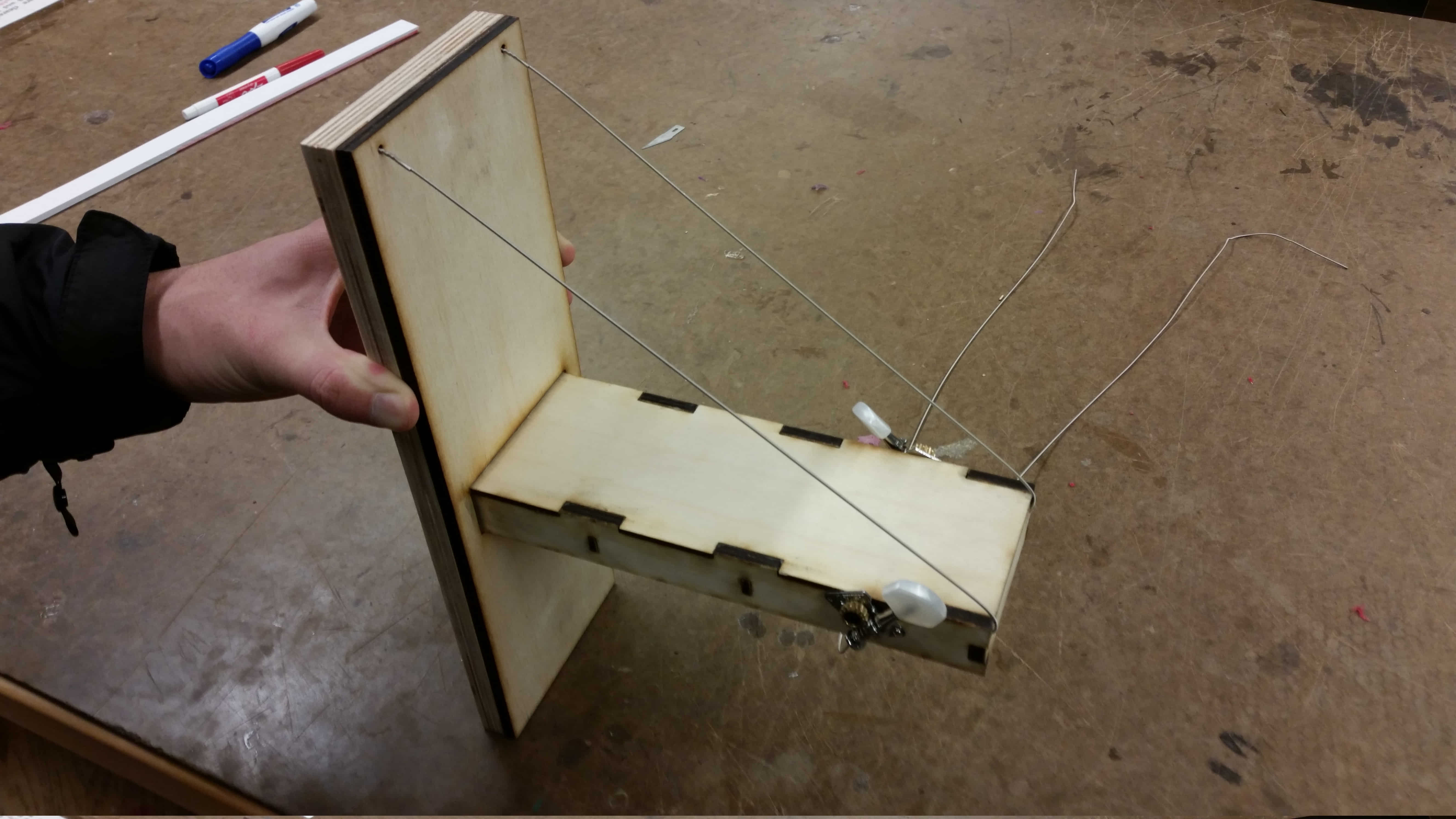
The final project for ENGS 33, Solid Mechanics during Fall 2017 was to build
a cantilever bridge and predict how it would fail. We were also supposed to
optimize its strength to weight ratio.
A cantilever bridge is supported only one side, and for this class, we had
a number of other restrictions. The bridge had to attach to a standardized
mount, and we could only use 1/8 in or 1/4 in laser cut plywood, as well as
guitar strings. Also, the bridge had to be roughly statically determinate.
“Doorman” was a device I created as part of a team during my ENGS 21
(Introduction to Engineering) class at Dartmouth College. This device is
designed to retrofit dorm deadbolt locks and allowed them to be opened with a
key card or smartphone.
This project won the Thayer School of Engineering Phillip R. Jackson Award and
was written about in the Dartmouth Engineer Magazine.
I was on a FIRST Robotics Competition (FRC) team for six years during middle
and high school. This experience was instrumental in my decision to pursue
engineering and computer science in college. Having previously participated
in FIRST Lego League competitions, I joined the FRC team at my high school
in seventh grade. In eighth grade, I became one of the drivers of the robot,
and in my sophomore year I became a captain of the team.